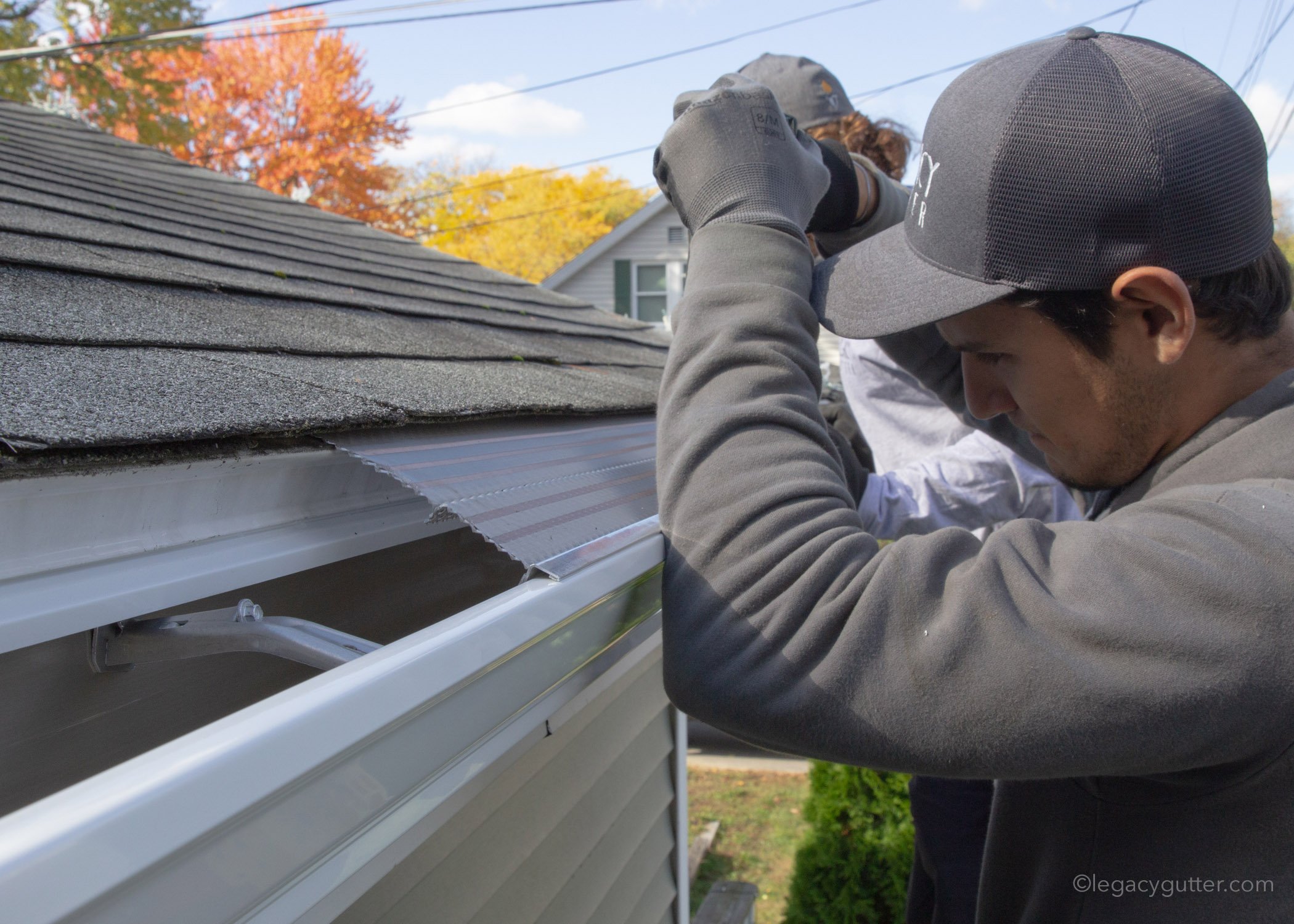
The short answer: Yes, a well-designed gutter guard works through a New England winter, as long as it's part of a properly pitched, well-anchored seamless system. A good guard keeps leaves and needles out, so meltwater can drain instead of freezing in a clogged trough. A guard can't stop snow or ice from forming on your roof, any guard can ice over in a long cold snap, and a poorly made one can sag or collapse. The guard and the gutter beneath it have to be built together.
By late October, the leaves are mostly down from the Monadnock region to the Seacoast and across northern Massachusetts. It's the moment many homeowners ask us the same question: if I add guards now, will they help or hurt once the snow arrives? Here's what we've learned building gutter systems for real New England winters.
What happens to gutters in a New England winter?
Winter here isn't one long freeze. It's a cycle. Snow settles on the roof, a sunny afternoon melts the bottom layer, and the meltwater runs to the gutters. At night the temperature drops and whatever water is still sitting in the system freezes. Repeat that for a week in Keene, Peterborough or Worcester and you can build up a surprising amount of ice.
Ice and snow is part of a gutter's life. All gutters and guards will get some icing and snow. It's inevitable, so we build our systems to withstand and endure it. It's common to get a cold snap in the middle of winter (typically February) that lasts a week or two (rarely 3). That stretch can cause heavy icing, and if it isn't managed well, ice dams can form. The gutters themselves don't create ice dams or the water that backs up behind them. Ice dams are almost always caused by excess heat escaping the roof, which sets off an unnatural freeze-thaw cycle at the eaves. That's why you need clean, clear gutters, downspouts and ground pipes (if you have them), along with a robust gutter system.
The gutters that struggle most are the ones that can't drain. Leaves and pine needles left in the trough act like a sponge, holding water right where it will freeze. That's where guards come in.
How do gutter guards help in winter?
A guard's job in winter is the same as in fall: keep debris out so water keeps moving. When the trough and downspouts stay clear:
Meltwater drains instead of pooling, which leaves less water behind to freeze overnight.
Downspouts are less likely to clog and freeze shut, a common cause of overflow and icy walkways (we covered this in Frozen Downspouts).
Less ladder work in cold weather. Fewer clogs means fewer reasons to climb an icy ladder in December.
In other words, guards don't fight ice directly. They remove one of the main conditions that lets ice build up.
Can gutter guards cause ice problems?
They can, if the wrong guard goes on the wrong system. The most common issues we see:
Flimsy guards that flex under snow. Thin or loosely fastened guards can bend, pop loose or collapse into the gutter under heavy, wet snow.
Guards that trap a layer of ice. Some designs hold water on the surface, where it freezes into a crust and lets snowmelt sheet over the edge. In a long cold snap, this can happen with any type of guard system.
Guards installed on a tired gutter. A guard can't fix poor pitch, failing hangers or undersized downspouts. If the gutter underneath sags, the guard sags with it.
Guards that are installed poorly. When guards are installed poorly, it's common to find them caving in or falling off from the heavy weight and movement of ice and snow during winter storms.
None of this means guards are a bad idea. It means the guard, the gutter and the roofline need to be designed as one system.
What makes a gutter guard winter-ready?
When you're comparing options, here's what matters most for our climate:
Rigid construction. A guard should hold its shape under a heavy snow load and not flex into the trough.
Secure fastening. It should be fastened to the gutter itself so it stays put through freeze-thaw cycles and snow sliding off the roof.
A surface that sheds water into the trough. Fine-mesh designs that let water pass through quickly, while keeping out needles and seeds, tend to hold up well.
A strong gutter underneath. Heavy-gauge seamless gutters, hangers spaced closely, and larger 3x4 downspouts give the guard a stable base. (More in Why Overbuilt Gutter Systems Matter in New England Winters.)
Professional installation. Proper pitch, outlet placement and roof-edge detail are what make the whole system perform.
Do guards stop ice dams?
No, and anyone who promises that is overselling. Ice dams form when heat escaping through the roof melts snow, and that water refreezes at the colder eave. As covered above, that heat loss is usually an insulation or ventilation issue, not a gutter problem. What a guard and a healthy gutter system can do is give meltwater a clear path off the roof, so you're not adding a clogged, frozen gutter on top of an ice dam. If you're seeing heavy icicles or ice ridges every winter, it's worth having both the roof and the gutters looked at. In certain instances, it makes sense to add a heavy-duty, self-regulating heat cable, run through the gutters and down the downspouts. This is useful for trouble areas that get little sunlight and excessive icing in the deep winter.
Should I add guards to my existing gutters or start fresh?
It depends on the gutters you have. If your system is seamless, properly pitched and solidly hung, adding guards can be a smart upgrade. If you're seeing sagging sections, leaking seams, standing water or undersized downspouts, putting a guard on top just covers the problem. In that case, a new seamless system designed with guards from the start is the better long-term investment.
This is something we see constantly across southern New Hampshire and northern Massachusetts, where many homes have older sectional gutters that were never built for our snow loads.
Is it too late in the season to add gutter guards?
No. Late fall is a good time, because the leaves are down and the trough can be fully cleaned before the guards go on. We also install and service gutters through the winter, weather permitting, so a project doesn't have to wait until spring. We may recommend waiting, though, if your existing gutters need to be replaced or can't be cleaned correctly because ice and debris are frozen inside them.
Frequently Asked Questions
Will snow sit on top of my gutter guards? Some snow can rest on any roof edge. A rigid, well-fastened guard is built to carry that weight and release meltwater into the trough as it thaws.
Do I still need gutter cleaning if I have guards? Guards are low maintenance, not no maintenance. An occasional check and brushing of the guard surface keeps it performing. See Do Gutter Guards Actually Work? for more.
Can guards be added to copper or half-round gutters? Often, yes. Guards can be matched to many profiles and materials, including copper, so the system keeps its look. We'll recommend the right option during a visit.
Will guards damage my roof? Not when they're properly installed. Fastening the guard to the gutter, rather than prying it under shingles, protects the roofline.
Ready for a winter-ready gutter system?
Whether you need guards for a sound system or a new seamless system designed around them, we'll look at your whole roofline, from pitch to downspouts to where the water goes. Legacy Gutter Solutions serves homeowners from Rindge and the Monadnock region to the Seacoast and northern Massachusetts.